"New York Stock Exchange" by David Blaikie is marked with CC BY 2.0.
The Securities and Exchange Commission proposed this week new Regulation SE under the Securities Exchange Act of 1934 (the Exchange Act) to create a regime for the registration and regulation of security-based swap execution facilities (SBSEFs). The new regulatory framework was one of the major reforms required under Title VII of the Dodd-Frank Wall Street Reform and Consumer Protection Act (Dodd-Frank Act) relating to the over-the-counter derivatives market.
“This proposal would increase the transparency and integrity of the traditionally opaque over-the-counter security-based swap market, fulfilling a mandate under the Dodd-Frank Act of 2010 to register and regulate the platforms that trade these instruments,” said SEC Chair Gary Gensler. “Among other things, today’s proposal would create a framework for the registration of security-based swap execution facilities, based upon the 14 core principles for these entities spelled out in the Dodd-Frank Act. This framework would harmonize with the swap execution facility framework promulgated by our sibling agency, the Commodity Futures Trading Commission.”
If adopted, today’s proposal would implement the Exchange Act’s trade execution requirement for security-based swaps and address the cross-border application of that requirement; implement Section 765 of the Dodd-Frank Act to mitigate conflicts of interest at SBSEFs and national securities exchanges that trade security-based swaps; and promote consistency between proposed Regulation SE and existing rules under the Exchange Act.
In developing this proposal, the Commission sought to harmonize as closely as practicable with parallel rules of the Commodity Futures Trading Commission (CFTC) that govern swap execution facilities (SEFs) and swap execution generally. The Commission seeks to obtain regulatory benefits comparable to those under the CFTC regime while minimizing costs imposed on SBSEFs and their members.
The Commission previously proposed rules regarding SBSEFs in three separate releases between 2010 and 2013. Given the length of time that has passed since they were issued and the significant market changes that have taken place in the interim, the Commission is withdrawing all previously proposed rules, rule amendments, and interpretations regarding SBSEFs.
The proposing release will be published on SEC.gov and in the Federal Register. The public comment period will remain open for 60 days following publication of the proposing release on the SEC’s website or 30 days following publication of the proposing release in the Federal Register, whichever period is longer.
AN IMPORTANT NOTE:On June 22, 2021, Hadari Oshri –Marc Lubaszka’s business partner– filed a frivolous civil harassment restraining order (CHRO) against Investor News reporter Aitana Vargas to stop the publication of her investigative series “A Special Report: The Harrowing Impunity of White-Collar crime,” and any subsequent installments or future media coverage. On August 3, 2021, Vargas filed an anti-SLAPP motion to strike Oshri’s CHRO petition. In a hearing held on September 13, 2021, Los Angeles Superior Court Judge Doreen Boxer granted Vargas’s anti-SLAPP motion and denied Oshri’s civil harassment petition for failure to sustain the applicable burden of proof. Oshri will now have to pay Vargas’s attorney’s fees for filing a frivolous case. The Israeli entrepreneur also declined to go on a recorded interview or provide statements via email.
2019 court case against Hadari Oshri exposes her dodgy, aggressive legal maneuvers
California – As Hadari Oshri’s Xehar, Inc. was falling through the cracks, her dodgy, aggressive legal tactics were exposed in a court case filed against her by former business associate Matthew Wilkinson back in May 2019.
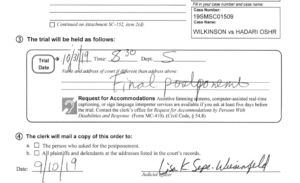
The case was initially scheduled for trial on August 6, 2019, but it was postponed several times at Oshri’s request on the basis that she was preoccupied with an “eviction” and that she’d would be out of the country for the “Holidays.”
Oshri’s exact words were: “I am asking from the court to postponment this case, ( check attchment )” because “My maind was dealling with the eviction situetion that I have with my apartment, I was busy in payment solution for my leandloaed, I came up with $14,000 ( check next page ).”
The court agreed to re-schedule the trial on October 10. However, on September 9, Oshri asked that the hearing be postponed again until October 24th or November 2019.
In court filings, Oshri wrote: “The court date is set up to be one day after Yom Kipur, I am not going to be in USA, until After the Holiday season, when the Jujed asked me if that date is Ok i was not ( check a…,”
Hadari Oshri accused of “stall tactics” to delay court proceedings
Court documents also show that Wilkinson was frustrated with Oshri’s delay tactics and asked the court to deny her request: “I ask that the Plaintiff’s request to postpone trial be denied as this is just another stall tactic being used by the defendant. Prior to our original court date on August 6, 2019, I received an email from the defendant with a 16-page answer to the court case, yet she said in court that she needed a postponement.”
The court granted Oshri’s request to delay the proceedings one last time and scheduled the trial for October 31, 2019.
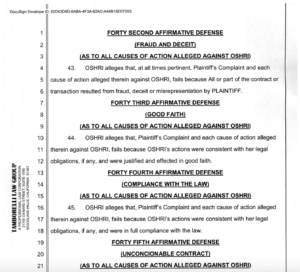
In addition to Oshri’s delay tactics, her Counsel, John Tamborelli, put together a reply to Wilkinson’s complaint invoking nearly every single affirmative defense in the book: a whopping 46 potential legal protections.
In her response, not only did Oshri deny responsibility, but she also accused Wilkinson of having “unclean hands,” having committed “fraud,” “deceit” and “misrepresentation.”
Tamborelli went on to argue that her client was “unfairly pressured” or “induced” by the “plaintiff into consenting to the contract” in a moment where Oshri was suffering “weakness of mind,” “financial pressure” and “distress.”
“Oshri would not otherwise have consented to the contract,” the reply says.
And as if nearly 50 affirmative defenseswere not enough to sway the Judge, Oshri still reserved the right to assert additional affirmative defenses.
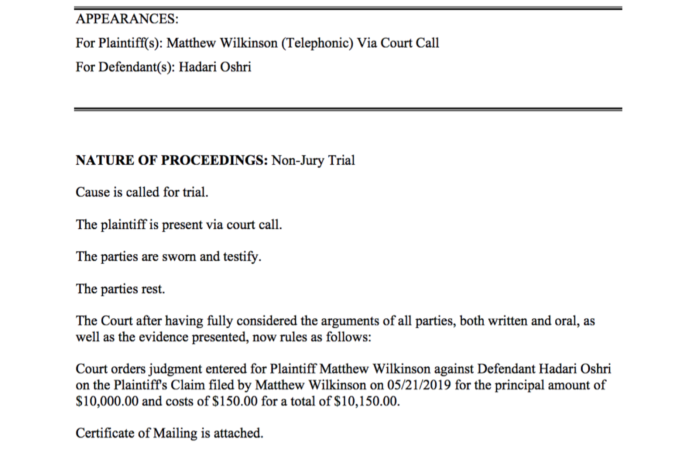
But Oshri’s startling legal plan didn’t fly with the court: None of the affirmative defenses portraying the plaintiff as an ill-intentioned businessman worked, and the judge ruled against her in the amount of $10,150.
Hadari Oshri ordered to pay judgment in full immediately
Court documents show that after losing her appeal, Oshri asked the court for mercy and proposed a payment plan. “I am working on my income and I do not have stable income at this moment to make big payment at once,” the fashion fairy entrepreneur stated.
Oshri’s request was denied and the court ordered her to pay the judgment in full, and to do so immediately.
Wilkinson didn’t respond to a request for comment.
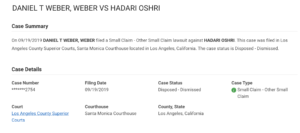
In 2019, Dan Weber filed a small claims court against Oshri for money owed. The case was never heard because he was unable to serve legal documents on her. She still has not paid off the debt.
**Since Hadari Oshri filed a meritless case against Investor News contributor Aitana Vargas and had previously declined to provide written comments or go on a recorded interview, it is our policy not to seek further comments from the entrepreneur. Oshri is always welcome to reach out and agree to the proposed interview terms. The same policy applies to her former Counsel, John Tamborelli.
***To contact the newsroom, send an email to info@investornews.io. To contact and send tips to news correspondent Aitana Vargas, use aitana_investigations@protonmail.com. All malicious emails, phone calls and text messages are reported to law enforcement.
"Jennifer Aniston's Yacht?" by RobW_ is marked with CC BY-NC-ND 2.0.
Note: Footage of the seizure is available here. View the statement from the Attorney General on today’s seizure here.
Spanish law enforcement this week executed a Spanish court order freezing the Motor Yacht (M/Y) Tango (the Tango), a 255-foot luxury yacht owned by sanctioned Russian oligarch Viktor Vekselberg. Spanish authorities acted pursuant to a request from the U.S. Department of Justice for assistance following the issuance of a seizure warrant, filed in the U.S. District Court for the District of Columbia, which alleged that the Tango was subject to forfeiture based on violation of U.S. bank fraud, money laundering, and sanction statutes. Separately, seizure warrants obtained in the U.S. District Court for the District of Columbia target approximately $625,000 associated with sanctioned parties held at nine U.S. financial institutions. Those seizures are based on sanctions violations by several Russian specially designated nationals.
According to documents filed in this case, the U.S. investigation alleges that Vekselberg bought the Tango in 2011 and has owned it continuously since that time. It further alleges that Vekselberg used shell companies to obfuscate his interest in the Tango to avoid bank oversight into U.S. dollar transactions related thereto. Additionally, after Vekselberg was sanctioned by the U.S. Treasury Department on April 6, 2018, the warrant alleges that Vekselberg and those working on his behalf continued to make U.S. dollar payments through U.S. banks for the support and maintenance of the Tango and its owners, including a payment for a December 2020 stay at a luxury water villa resort in the Maldives and mooring fees for the yacht. Vekselberg had an interest in these payments and therefore a license was required from the Treasury Department, which was not obtained.
“Today marks our taskforce’s first seizure of an asset belonging to a sanctioned individual with close ties to the Russian regime. It will not be the last,” said Attorney General Merrick B. Garland. “Together, with our international partners, we will do everything possible to hold accountable any individual whose criminal acts enable the Russian government to continue its unjust war.”
“Today’s action makes clear that corrupt Russian oligarchs cannot evade sanctions to live a life of luxury as innocent Ukrainians are suffering,” said Deputy Attorney General Lisa O. Monaco. “Today the Department of Justice delivers on our commitment to hold accountable those whose criminal activity strengthens the Russian government as it continues to wage its unjust war in Ukraine. That commitment is one we are not finished honoring.”
“Today we announce another example of the FBI using our worldwide presence and partnerships, as well as our expertise and experience, to track and seize illicit money and assets, to counter threats to our safety and national security,” said FBI Director Christopher Wray. “We will continue to use every lawful tool to go after designated Russian oligarchs’ assets – however and wherever they hide them.”
The seizure was coordinated through the Justice Department’s Task Force KleptoCapture, an interagency law enforcement task force dedicated to enforcing the sweeping sanctions, export restrictions, and economic countermeasures that the United States has imposed, along with its allies and partners, in response to Russia’s unprovoked military invasion of Ukraine. Announced by the Attorney General on March 2 and run out of the Office of the Deputy Attorney General, the task force will leverage all the Department’s tools and authorities against efforts to evade or undermine the economic actions taken by the U.S. government in response to Russian military aggression.
“The seizure of this luxury yacht demonstrates our determination to hold accountable those who support Vladimir Putin’s unwarranted invasion of another sovereign nation,” said U.S. Attorney Matthew M. Graves for the District of Columbia. “We will continue to use every tool to enforce the sanctions aimed at Putin’s regime and the oligarchs who support it. Working with our federal and international partners, we will be unflagging in our efforts to bring to justice those who violate these sanctions, and to seize assets where appropriate and lawful.”
“Today’s seizure of Viktor Vekselberg’s yacht, the Tango, in Spain is the result of an unprecedented multinational effort to enforce U.S. sanctions targeting those elites who have enabled Russia’s unprovoked and illegal invasion of Ukraine,” said Director Andrew Adams of Task Force KleptoCapture. “For those who have tied their fortunes to a brutal and lawless regime, today’s action is a message that those nations dedicated to the rule of law are equally dedicated to separating the oligarchs from their tainted luxuries. This seizure is only the beginning of the Task Force’s work in this global effort to punish those who have and continue to support tyranny for financial gain.”
“The FBI will continue to work with its partners to protect the integrity of the banking system and support the enforcement of sanctions programs,” said Special Agent in Charge Michael F. Paul of the FBI’s Minneapolis Field Office. “FBI agents and analysts, regardless of where they are assigned around the world, will work tirelessly to ensure those who attempt to evade sanctions are held accountable.”
“The Russian invasion of Ukraine was an unprovoked act of aggression that has targeted the lives and well-being of millions of people and threatened international security,” said Acting Special Agent in Charge Ricky J. Patel of Homeland Security Investigations (HSI) New York. “For decades, the Putin regime has been supported by a group of Russian oligarchs that abused their power for private gain to amass untold riches. As DHS’s investigative arm, HSI stands at the forefront of combatting global networks that seek to violate U.S. law and exploit our nation’s financial systems. Working with our partners at the U.S. Department of Justice and the FBI, we will hold Putin’s oligarchs accountable and deny them the lavish lifestyles they cherish.”
Upon receipt of a request from the United States pursuant to a bi-lateral treaty for mutual legal assistance in criminal matters, the Spanish central authority for mutual legal assistance forwarded the request to a Spanish prosecutor, who obtained a freezing order from a Spanish court. The order was executed by Spain’s Guardia Civil on April 4.
The Tango, International Maritime Organization number 1010703, is believed to be worth approximately $90 million or more. The yacht is now in Mallorca.
The burden to prove forfeitability in a forfeiture proceeding is upon the government.
The matter of the Tango is being investigated by the FBI’s Minneapolis Field Office with assistance from the HSI New York Field Office.
Assistant U.S. Attorney Karen P. Seifert for the District of Columbia and Paralegal Brian Rickers and Legal Assistant Jessica McCormick for the District of Columbia are handling the seizure. The Justice Department’s Office of International Affairs provided significant assistance in working with the Spanish authorities, as well as the Criminal Division’s Money Laundering and Asset Recovery Section (MLARS).
"MTA Deploys PPE Vending Machines Across Subway System" by MTAPhotos is marked with CC BY 2.0.
An Oklahoma woman pleaded guilty in the Western District of New York for a scheme to defraud the Paycheck Protection Program (PPP) of over $43.8 million in COVID-19 relief loans guaranteed by the Small Business Administration (SBA) under the Coronavirus Aid, Relief, and Economic Security (CARES) Act.
According to court documents, Amanda J. Gloria, 45, of Altus, admitted that she conspired to submit at least 153 fraudulent PPP applications seeking a total of approximately $43.8 million on behalf of at least 111 entities between approximately May 2020 and June 2021. Gloria admitted that she falsified or aided and assisted with falsifying various information on these loan applications, including the number of employees, payroll expenses and documentation, and federal tax filings. Gloria then submitted or aided and assisted with the submission of the fraudulent PPP applications to financial institutions. In total, the recipient entities unlawfully obtained approximately $32.5 million in PPP funds. From those fraudulently obtained funds, Gloria personally received at least approximately $1.7 million.
Gloria also admitted that she conspired with Adam D. Arena to submit a fraudulent PPP loan application seeking approximately $954,000 for ADA Auto Group LLC, a previously inactive Florida-based business owned and controlled by Arena. After fraudulently obtaining the PPP loan, Gloria directed Arena to launder the proceeds, including by transferring nearly $25,000 to a bank account held in the name of WildWest Trucking LLC, an Oklahoma-based business owned and controlled by Gloria. Gloria also admitted that she submitted and fraudulently obtained a separate PPP loan for WildWest Trucking LLC for approximately $421,000. Arena pleaded guilty in November 2021 to one count of conspiracy to commit bank fraud and one count of engaging in a monetary transaction with criminally derived proceeds in a related case.
Gloria is scheduled to be sentenced on July 20 and faces up to 30 years in prison for conspiracy to commit bank fraud and up to 10 years in prison for money laundering. A federal district judge will determine any sentence after considering the U.S. Sentencing Guidelines and other statutory factors.
Assistant Attorney General Kenneth A. Polite, Jr. of the Justice Department’s Criminal Division; U.S. Attorney Trini E. Ross for the Western District of New York; Assistant Director Luis Quesada of the FBI’s Criminal Investigative Division; Special Agent in Charge Stephen Belongia of the FBI’s Buffalo Field Office; and Special Agent in Charge Thomas Fattorusso of IRS Criminal Investigation (IRS‑CI) made the announcement.
The FBI and IRS-CI are investigating the case.
Assistant Chief Cory E. Jacobs and Trial Attorney Jennifer Bilinkas of the Criminal Division’s Fraud Section and Assistant U.S. Attorney Laura A. Higgins for the Western District of New York are prosecuting the case.
The Fraud Section leads the Criminal Division’s prosecution of fraud schemes that exploit the PPP. Since the inception of the CARES Act, the Fraud Section has prosecuted over 150 defendants in more than 95 criminal cases and has seized over $75 million in cash proceeds derived from fraudulently obtained PPP funds, as well as numerous real estate properties and luxury items purchased with such proceeds. More information can be found at https://www.justice.gov/criminal-fraud/ppp-fraud.
On May 17, 2021, the Attorney General established the COVID-19 Fraud Enforcement Task Force to marshal the resources of the Department of Justice in partnership with agencies across government to enhance efforts to combat and prevent pandemic-related fraud. The Task Force bolsters efforts to investigate and prosecute the most culpable domestic and international criminal actors and assists agencies tasked with administering relief programs to prevent fraud by, among other methods, augmenting and incorporating existing coordination mechanisms, identifying resources and techniques to uncover fraudulent actors and their schemes, and sharing and harnessing information and insights gained from prior enforcement efforts. For more information on the department’s response to the pandemic, please visit https://www.justice.gov/coronavirus.
Anyone with information about allegations of attempted fraud involving COVID-19 can report it by calling the Department of Justice’s National Center for Disaster Fraud (NCDF) Hotline at 866‑720‑5721 or via the NCDF Web Complaint Form at https://www.justice.gov/disaster-fraud/ncdf-disaster-complaint-form.
"Arresting a cybercriminal for mail fraud" by Eric Fischer is marked with CC BY 2.0.
An Estonian man has been sentenced to 66 months in prison for his years-long role in furthering and facilitating computer intrusions, the movement of fraudulently obtained goods and funds, and the monetization of stolen financial account information. He also participated in ransomware attacks causing over $53 million in losses and was ordered to pay over $36 million in restitution.
According to court documents, Maksim Berezan, 37, of Estonia, who was apprehended in Latvia and extradited to the United States, pleaded guilty in April 2021 to conspiracy to commit wire fraud affecting a financial institution and conspiracy to commit access device fraud and computer intrusions. Berezan was an active member of an exclusive online forum designed for Russian-speaking cybercriminals to gather safely and exchange their criminal knowledge, tools, and services. From 2009 through 2015, Berezan not only furthered the criminal aims of the forum, but he also worked closely with forum members and other cybercriminals for purposes of obtaining and exploiting stolen financial account information.
“This case is a prime example of how the Department of Justice can leverage its traditional tools – criminal investigations and prosecutions – to combat ransomware,” said Assistant Attorney General Kenneth A. Polite Jr. of the Justice Department’s Criminal Division. “Many of the world’s ransomware players began as fraudsters engaged in other types of online crimes, and this case demonstrates that their crimes will catch up to them. The United States is committed to working with its international partners to hold cybercriminals accountable.”
“Cybercrime has become increasingly more sophisticated, but so have our methods for combatting it,” said U.S. Attorney Jessica D. Aber for the Eastern District of Virginia. “Ransomware attacks are devastating to people and organizations alike, and we have honed our strategies and techniques to target both the individual actors who perpetrate these attacks and the networks that support them. This case is just one example of how EDVA and the Justice Department are tackling this threat.”
“The Secret Service remains committed to ensuring that modern conveniences of today that facilitate our lawful transactions and economic health are not leveraged by criminals for illicit activity and personal gain,” said Special Agent in Charge Matthew Stohler of the U.S. Secret Service. “While we have long been in the business of protecting money, from the earliest days of coins and paper, to plastic, and today’s more accessible and commonplace digital currencies, we also remain in parallel footprint to the evolution of criminal behavior into cyberspace. Ransomware thieves are not safe in any dark corner of the internet in which they may think they can hide from our highly trained investigators and law enforcement partners worldwide. Together with our critical partners we are dedicated to protecting the public and securing every iteration of our money and every part of our national financial infrastructure.”
According to court documents, following Berezan’s arrest, investigators uncovered within his electronic devices evidence of his involvement in ransomware activities. The post-extradition investigation determined that Berezan had participated in at least 13 ransomware attacks, seven of which were against U.S. victims, and that approximately $11 million in ransom payments flowed into cryptocurrency wallets that he controlled. Berezan used his ill-gotten gains to purchase two Porsches, a Ducati motorcycle, and an assortment of jewelry. In addition, authorities recovered from Berezan’s residence currency worth more than $200,000 and electronic devices storing passphrases to bitcoin wallets that contained bitcoin worth approximately $1.7 million, which has been forfeited.
Assistant Attorney General Kenneth A. Polite Jr. of the Justice Department’s Criminal Division; U.S. Attorney Jessica D. Aber for the Eastern District of Virginia; Special Agent in Charge Matthew Stohler of the Washington Field Office of the U.S. Secret Service and Special Agent in Charge Jason Kane of the Criminal Investigative Division of the U.S. Secret Service made the announcement.
Senior Trial Attorney Laura Fong and Trial Attorney Alison Zitron of the Criminal Division’s Computer Crime and Intellectual Property Section, and Assistant U.S. Attorneys Alexander P. Berrang, Jonathan Keim, and Zoe Bedell of the Eastern District of Virginia prosecuted the case.
The Justice Department’s Office of International Affairs provided vital assistance. The Department of Justice extends its gratitude to authorities in Estonia and Latvia for their significant cooperation and assistance, in particular, the Latvian State Police and Estonian Police.
"Stock Exchange" by Travel Aficionado is marked with CC BY-NC 2.0.
The Securities and Exchange Commission has charged Melville ten Cate, a U.S. citizen residing abroad, with fraud stemming from his allegedly phony offer to purchase Textron – a large U.S.-listed aircraft, defense, and industrial company.
The SEC’s complaint, filed in federal district court in Manhattan, alleges that on November 9, 2020, ten Cate and Xcalibur Aerospace, Ltd., a now-defunct private company ten Cate controlled, placed an advertisement in The New York Times announcing a proposed purchase of all existing stock of Textron for $60.50 a share, a 56 percent premium over the stock’s previous closing price. As alleged, the advertisement led to a spike in Textron trading and a subsequent trading halt. The SEC has charged ten Cate with violating the antifraud provisions of the federal securities laws.
According to the complaint, the announcement was false and misleading because ten Cate and Xcalibur lacked the financial resources to complete the transaction, which would have required more than $14 billion. The tender offer announcement allegedly described Xcalibur’s corporate parent as a ‘diversified global investment company,’ when it had no operations or assets and had been deactivated for failure to pay taxes. The complaint alleges that the announcement failed to disclose that ten Cate and entities he controlled had been the subject of multiple bankruptcy and default judgments and that Textron had previously rejected Xcalibur’s overtures. The SEC’s investigation also allegedly confirmed that the defendant attempted to access the Commission’s online Electronic Data Gathering and Retrieval (EDGAR) system in order to complete the required process for a public filing but was thwarted by SEC officials.
“We allege that the defendant, ten Cate, pretended to run a financially viable business while leaving a trail of bad debts that included never paying for the very advertisement that announced the fictitious offer,” said Carolyn Welshhans, Associate Director of the SEC’s Division of Enforcement. “The SEC will continue to pursue those who disrupt our markets and spread materially misleading information to investors through the media or the SEC’s EDGAR system.”
The SEC is seeking permanent and conduct-based injunctions, a penalty, and an officer and director bar. In a parallel action, the U.S. Attorney’s Office for the Southern District of New York today announced criminal charges against ten Cate.
The investigation was conducted by Edward Reilly and Brian Vann and supervised by Amy Friedman and Ms. Welshhans. The litigation will be conducted by Duane Thompson and supervised by Melissa Armstrong. The SEC appreciates the assistance of the U.S. Attorney’s Office for the Southern District of New York and U.S. Department of Homeland Security.
"MGM Sports Book" by relux. is marked with CC BY-NC-SA 2.0.
LOS ANGELES – Federal authorities today announced a series of cases stemming from an illegal gambling operation that involved current and former professional athletes, some of whom assisted with the business and others who placed large bets on games.
In documents unsealed Wednesday in United States District Court, the principals of the operation agreed to plead guilty to conspiracy charges and admitted they took in millions of dollars in bets, many of which were facilitated by a Costa Rica-based gambling website. One of the leaders of the scheme also admitted that he failed to report to the IRS nearly $1.5 million in income he received from the gambling scheme over two years.
The owner of the online gambling business and website pleaded guilty earlier this month and admitted the business was illegal under California law because it involved at least five people, operated for at least six years, and often had gross revenue of well over $2,000 on a single day.
Four new cases and related plea agreements were unsealed this week against:
Wayne Nix, 45, of Newport Coast, a former minor league baseball player, who was charged with one count of conspiring to operate an illegal sports gambling business, and one count of filing a false tax return;
Edon Kagasoff, 44, of Lake Forest, Nix’s longtime partner in the operation, who was charged with one count of conspiring to operate an illegal sports gambling business;
Howard Miller, 63, of Gardena, who was charged with one count of aiding and abetting the operation of an illegal sports gambling business by assisting in the collection and payout of gambling proceeds related to the Costa Rica-based website; and
Celebrity Financial LLC, dba Sherman Oaks Check Cashing, which was charged with failing to maintain an effective money laundering program related to it cashing at least $18 million in checks from the illegal sport gambling business at its San Fernando Valley check cashing store.
Representatives of Celebrity Financial appeared in court on March 28. Nix made his first court appearance Wednesday afternoon, and he is scheduled to formally enter his guilty plea on April 11. Miller has agreed to appear in court this afternoon, and Kagasoff has agreed to appear in court on Friday.
The Justice Department also announced that earlier this month the court unsealed cases against two other defendants:
Kenneth Arsenian, 52, of Newport Beach, who pleaded guilty on January 26 to four charges: operating an illegal sports gambling business, filing a false tax return, money laundering, and accepting a financial instrument for unlawful internet gambling; and
Joseph Castelao, 56, of Rancho Palos Verdes, the owner of the gambling website – Sand Island Sports – who pleaded guilty on March 15 to operating an illegal gambling business.
According to the court documents made public this week, Nix began operating a bookmaking business about 20 years ago. Through his contacts in the sports world, Nix developed a client list that included current and former professional athletes, and he employed three former Major League Baseball players to assist with the business.
Kagasoff joined Nix in the gambling operation around 2014, and they used an online infrastructure and calling center operated by Sand Island Sports to create accounts for bettors, according to court documents, which note that Nix and his associates paid winning bets and retained nearly all of the money collected from bettors.
Nix’s plea agreement outlines specific incidents related to the betting scheme, including receiving payments for gambling losses from a professional football player, a Major League Baseball coach and a baseball analyst. The plea agreement also discusses a bettor who wagered $1 million a year with Nix’s operation, a $5 million bet on the 2019 Super Bowl, and a sports broadcaster who told Nix he was going to refinance his home to pay off gambling debts.
In relation to the tax count against him, Nix admitted receiving $1,466,947 in income that he failed to report on his 2017 and 2018 federal income tax returns. In his plea agreement, Nix agreed to pay all back taxes due for those years – a total of $1,248,429, which includes the back taxes, penalties and interest. Nix also agreed to forfeit to the government nearly $1.3 million seized in February 2020 from two bank accounts and two brokerage accounts he controlled.
When Arsenian pleaded guilty in January, he admitted failing to report to the IRS more than $2.8 million in income for the years 2015 through 2018. Arsenian has agreed to pay $1.1 million in back taxes, plus additional penalties and interest. Arsenian also agreed to forfeit $341,459 in United States currency seized from his residence in February 2020.
In its plea agreement, Sherman Oaks Check Cashing admitted that it encouraged customers to bring large business checks – far in excess of the $10,000 that normally triggers a Currency Transaction Report (CTR) to federal authorities – and employees of the company told customers that it would not file CTRs. As a result, many of its customers brought checks that were proceeds of unlawful activity, including two customers of the gambling operation who cashed at least $18.35 million in checks. Sherman Oaks Check Cashing admitted that it made at least $500,000 in profits by engaging in this activity. In its plea agreement, the company agreed to pay a $500,000 fine, which is the maximum penalty under the law.
Homeland Security Investigations (HSI) and IRS Criminal Investigation are conducting the ongoing investigation in this matter. The HSI agents are part of the El Camino Real Financial Crimes Task Force.
Assistant United States Attorneys Jeff Mitchell of the Major Frauds Section and Dan Boyle of the Asset Forfeiture Section are prosecuting these cases.
"Dog Park_2009-03-03_IMG_5246.JPG" by Jim's Photos1 is marked with CC BY-NC 2.0.
A federal court this week ordered a Carneys Point, New Jersey company to stop distributing adulterated pet food in violation of the Federal Food, Drug and Cosmetic Act (FDCA).
In a complaint filed March 15, the United States alleged that Bravo Packing Inc., and its owners and operators, Joseph Merola and Amanda Lloyd, violated the FDCA by distributing adulterated animal food and by causing animal food to become adulterated while held for sale. The complaint alleged that samples collected during U.S. Food and Drug Administration (FDA) inspections of the Bravo facility in July 2019 and April 2021 contained Salmonella, a pathogenic microorganism that can cause the illness known as salmonellosis in both humans and animals. Salmonella can be transferred from animal food to humans through handling of the food, or directly from infected animals to humans. Salmonellosis can cause symptoms such as diarrhea, fever and abdominal cramps that last several days in healthy adults. Absent prompt treatment, salmonellosis can cause severe dehydration and even death in infants, young children, the elderly, transplant recipients, pregnant women and individuals with weakened immune systems.
“Animal food manufacturers must ensure that their products are safe,” said Principal Deputy Assistant Attorney General Brian M. Boynton, head of the Justice Department’s Civil Division. “The department will continue to work closely with the FDA to ensure that pet food is manufactured in compliance with the law.”
“The food we give our pets should be safe for them to eat and safe for people to handle,” said Director Steven Solomon, DVM, MPH of the FDA’s Center for Veterinary Medicine. “The FDA has taken this action to protect public health because, despite multiple inspections, notifications of violations and recalls, this firm continued to operate under insanitary conditions and produce pet food contaminated with harmful bacteria. We will not tolerate firms that put people or animals at risk and will take enforcement actions when needed.”
The defendants agreed to settle the suit and be bound by a consent decree of permanent injunction. The negotiated consent decree requires, among other things, that the defendants stop receiving, processing, manufacturing, preparing, packing, holding and distributing adulterated pet food until they take specific remedial measures and demonstrate to the FDA that they will comply with federal law.
The government was represented by Trial Attorney Noah T. Katzen of the Civil Division’s Consumer Protection Branch, with the assistance of Tara Boland of the FDA’s Office of Chief Counsel. The U.S. Attorney’s Office for the District of New Jersey also provided assistance.
Additional information about the Consumer Protection Branch and its enforcement efforts may be found at http://www.justice.gov/civil/consumer-protection-branch.
In 2017, Hadari Fashion Power House, Incorporated was sued for copyright infringement by Star Fabrics, Incorporated.
AN IMPORTANT NOTE:On June 22, 2021, Hadari Oshri –Marc Lubaszka’s business partner– filed a frivolous civil harassment restraining order (CHRO) against Investor News reporter Aitana Vargas to stop the publication of her investigative series “A Special Report: The Harrowing Impunity of White-Collar crime,” and any subsequent installments or future media coverage. On August 3, 2021, Vargas filed an anti-SLAPP motion to strike Oshri’s CHRO petition. In a hearing held on September 13, 2021, Los Angeles Superior Court Judge Doreen Boxer granted Vargas’s anti-SLAPP motion and denied Oshri’s civil harassment petition for failure to sustain the applicable burden of proof. Oshri will now have to pay Vargas’s attorney’s fees for filing a frivolous case. The Israeli entrepreneur also declined to go on a recorded interview or provide statements via email.
Oshri’s “Hadari Power Fashion House, Inc.” is no longer active
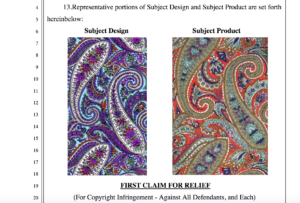
California – One of Hadari Oshri’s now-defunct companies, Hadari Power Fashion House, Inc., was sued in 2017 for copyright infringement, according to court documents obtained by this outlet.
The complaint, filed by CA-based Star Fabrics, Inc. also names Azules and Perfect Ink, Inc. as defendants and alleges that Oshri’s company sold an item under the brand Azules indicating that it was manufactured by or for Azules.
The complaint states that Hadari Power Fashion House, Inc. and the other two defendants manufactured, distributed and/or sold fabric and/or garments featuring a design that was “either identical or substantially similar” to the one registered with the United States Copyright Office by plaintiff Star Fabrics without the latter’s authorization.
*Read the complaint against Hadari Power Fashion House here.
A complaint filed against Hadari Power Fashion House, Inc. accused the company of copyright infringement.
By creating, distributing and/or selling derivative works through a nationwide network of retail stores, catalogues, and through on-line websites, each of the defendants infringed Star Fabrics’s copyrights, the complaint states.
The document further alleges that the defendants had “actual or constructive knowledge” of the plaintiff’s rights and that their acts were “willful, intentional and malicious.”
Star Fabrics asked for all profits of defendants, all losses incurred, statutory damages and attorneys’ fees.
The case was filed in the Central District of California on April 19, 2017. In July that year, Judge Fernando M. Olguin gave Star Fabrics until July 31, 2017 to serve defendant Hadari Power Fashion House, Incorporated and deliver proof of service by August 2, 2017.
Hadari Power Fashion House, Inc. was created in 2016 and its current status is “SOS/FTB Suspended.”
Oshri is the managing director of Trade Safe Pro, LLC and, along with her partner Patrick Seller, one of the principals of A1A Management, Inc., a company formed in Montana and registered at a luxurious beachfront Malibu condo, just like Trade Safe Pro.
A months-long exposé published on this outlet revealed Oshri’s alleged participation in a joint PPE scheme with conman Marc Lubaszka. The entrepreneurs used Lubaszka’s Fly Private X – whose VP was rapper Dylan Raw – to try to sell millions of dollars worth of PPE that they allegedly didn’t possess. The jet company’s official website went “under construction” following the release of part one of the investigative series and misrepresented that they had fleets of private jets that nobody has seen to this date.
Do you have a newsworthy story idea? Have you been SLAPPED? Contact the newsroom at info@investornews.io and share your story with us.
"Clariant Medical Masterbatches" by Clariant International Ltd. is marked with CC BY-NC-ND 2.0.
A Texas physician has been convicted for unlawfully prescribing more than one million pills of the opioid hydrocodone.
According to court documents and evidence presented at trial, James Pierre, 52, a doctor, of Houston, unlawfully prescribed controlled substances from June 2015 through July 2016 to individuals posing as patients at West Parker Medical Clinic (West Parker), a pill-mill clinic located in Houston.
Trial evidence showed that Pierre, along with his physician assistant, issued unlawful prescriptions for hydrocodone and carisoprodol, a combination of controlled substances known as the “Las Vegas Cocktail,” to hundreds of individuals posing as patients each week. So-called “runners” brought numerous people to pose as patients at West Parker and paid approximately $220 to $500 in cash for each visit that resulted in prescriptions for dangerous drugs. Throughout the scheme, West Parker made approximately $1,750,000 from prescriptions, and over $300,000 went to Pierre.
Pierre was convicted of one count of conspiracy to unlawfully distribute and dispense controlled substances and seven counts of unlawfully distributing and dispensing controlled substances. He is scheduled to be sentenced on June 27 and faces up to 20 years in prison for each count. A federal district court judge will determine the sentence after considering the U.S. Sentencing Guidelines and other statutory factors.
To date, one co-conspirator has pleaded guilty to conspiracy to unlawfully distribute controlled substances.
Assistant Attorney General Kenneth A. Polite Jr. of the Justice Department’s Criminal Division; U.S. Attorney Jennifer Lowery for the Southern District of Texas; and Special Agent in Charge Daniel C. Comeaux of the DEA’s Houston Division made the announcement.
DEA Houston investigated the case.
Trial Attorney John-Alex Romano of the Criminal Division’s Human Rights and Special Prosecutions Section and Trial Attorney Maryam Adeyola of the Criminal Division’s Fraud Section are prosecuting the case. Assistant U.S. Attorney Jon Muschenheim of the Southern District of Texas is handling forfeiture.



 Tamborelli went on to argue that her client was “unfairly pressured” or “induced” by the “plaintiff into consenting to the contract” in a moment where Oshri was suffering “weakness of mind,” “financial pressure” and “distress.”
 **Since Hadari Oshri filed a