
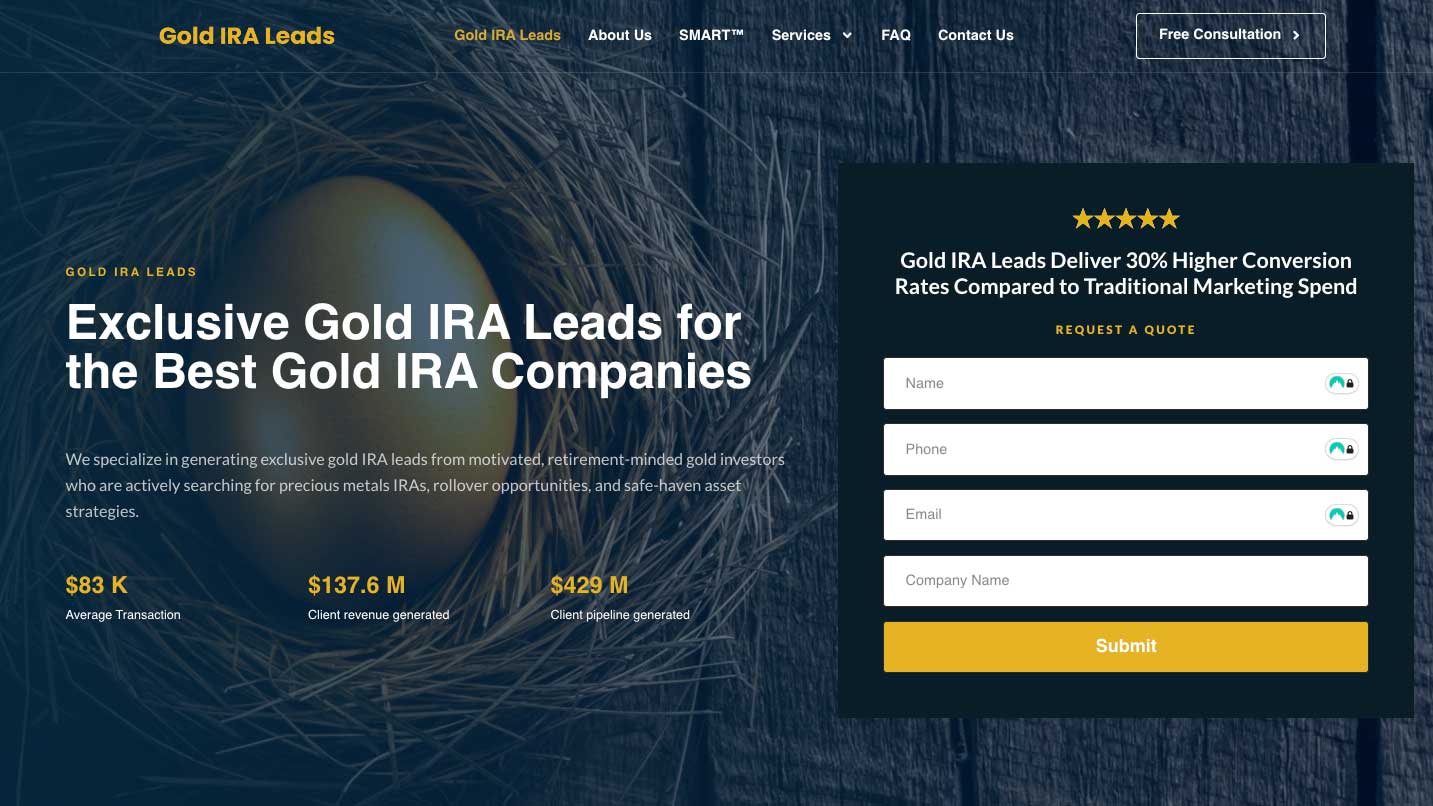


Gold IRA Leads: How SMART Tech Delivers Exclusive Investors at a $45 CPL
In a sector where compliant, high-intent investors are notoriously difficult to reach, one company—
Gold IRA Leads—is drawing attention for routinely delivering exclusive inquiries at approximately
$45 cost per lead (CPL). This report examines the process, the technology, and the discipline behind that figure, and why the approach is gaining traction among gold and precious metals firms that have seen diminishing returns from traditional tactics.
What Are Gold IRA Leads?
Gold IRA leads are prospective investors who express active interest in transferring or rolling over qualified retirement funds into a self-directed Individual Retirement Account backed by physical precious metals. Unlike broad financial audiences, this group tends to skew older (often 45+), asset-aware, and intent-driven—more interested in wealth preservation than speculative trading. Because of the complexity and compliance sensitivity of rollovers, each inquiry carries a higher potential value but also requires more education and trust-building.
The company Gold IRA Leads focuses on generating these inquiries through live, inbound demand rather than recycling or brokering lists. The emphasis is on intent rather than volume: prospective investors who have engaged with educational content, opted in, and are ready to learn more.
Why Quality Gold IRA Leads Are Hard to Acquire
For years, gold and precious metals marketers leaned on aged data, list rentals, and aggressive call-center tactics. As privacy expectations and regulations evolved—and as investors grew weary of repeated contact from multiple companies—performance degraded. Conversion rates declined while acquisition costs rose. Moreover, non-compliant promotion in financial services can invite regulatory scrutiny, creating risk for both vendors and brands.
The net effect: a challenging acquisition environment where many firms pay high CPLs for indifferent results, struggle to attribute outcomes to channels, and face brand fatigue among the very investors they hope to reach.
Industry Costs & Benchmarks
CPLs in the broader precious-metals category vary widely by channel, funnel design, and brand strength. It is common to see costs above $80–$150 for campaigns that depend on generic search terms, wide targeting, or weak conversion experiences. Against that backdrop, a ~$45 CPL for exclusive, compliant Gold IRA leads stands out—especially when paired with measurable intent signals and transparent attribution.
It is not just the price point that matters, however; it is the consistency. An approach that reliably converts attention into qualified conversations at a sustainable CPL enables predictable pipeline planning, smarter media allocation, and more disciplined scaling.
Inside the SMART Tech Framework
Gold IRA Leads attributes much of its performance to a SMART framework—Segmentation, Messaging, Automation, Retargeting, and Tracking. While the acronym is simple, the implementation is rigorous and technical.
Segmentation: Finding the Right Investors
Audience models prioritize indicators correlated with rollover likelihood: age bands, retirement account status, geography, device patterns, and media consumption paired with time-of-day responsiveness. Instead of treating all prospects equally, the system builds cohorts that receive distinct creative and sequencing to reduce waste and surface intent earlier.
Messaging: Education Over Hype
The content strategy leads with education—tax implications, rollover timelines, custodial considerations, storage options—rather than promises of quick gains. Landing pages present balanced, plain-language explanations and steer clear of exaggerated claims. This tone both improves platform compliance and builds trust with a demographic that rewards clarity.
Automation: Real-Time Capture and Routing
Automation handles the critical middle mile: capturing inquiries, validating contact details, enriching with consented data where appropriate, and routing to the correct sales workflow.
Response SLAs are minutes, not hours. When a prospect opts in, the system acknowledges, sets expectations, and—if relevant—offers scheduling or provides compliant educational material while a representative prepares outreach.
Retargeting: Respectful, Multi-Touch Follow-Up
Many serious investors do not convert on the first visit. The framework therefore layers privacy-aware retargeting and permission-based channels (notably SMS and email) to re-engage visitors who reviewed materials but did not book. Messaging remains informational: updates on market mechanics, rollover checklists, and FAQs about custodians and storage.
Tracking: Attribution You Can Trust
End-to-end tracking with robust UTM standards, call-tracking, and first-party analytics gives clients visibility into where leads originate and how they progress. This transparency allows budget to be shifted toward proven segments and away from vanity metrics.
Compliance-First Acquisition
Marketing financial products requires care. The acquisition program intentionally bakes compliance into creative review, disclosures, consent capture, and data handling. Educational content is vetted for balance, advertising claims avoid projections, and opt-in flows record consent with time stamps. These practices protect investors and brands, and help maintain long-term deliverability in permissioned channels.
Exclusivity & Lead Integrity
A persistent complaint in this industry is recycled contacts marketed as “exclusive.” The Gold IRA Leads model routes each inquiry to a single client, which reduces consumer fatigue and improves conversion rates. Exclusivity also enhances sales morale: representatives can spend their time nurturing one-to-one conversations rather than competing against parallel pitches.
From Click to Call: Converting Silent Researchers
Older, high-asset audiences often prefer phone calls over web forms. During pilots, an AI-assisted front line filters routine questions, captures callbacks, and escalates complex inquiries to licensed professionals. SMS has proven especially effective for respectful nudges (“Would you like the rollover checklist?”) and for confirming appointment logistics. This reduces no-shows and preserves momentum once intent is signaled.
Why $45 CPL Matters: Unit Economics
Consider a simplified model. If a firm acquires 1,000 exclusive inquiries at $45 CPL, media spend totals $45,000. At a modest 10% appointment-set rate and a 25% close rate from appointments, 25 new accounts are opened. If the average funded amount yields even a conservative commission, the unit economics can be compelling—especially when compared to higher-cost, non-exclusive leads that demand heavier dialing and lower win rates.
Because tracking and segmentation are tight, learnings compound: high-yield segments receive more budget; creative variants that underperform are sunset; and follow-up cadences are tuned to minimize drop-off. The result is a pipeline that stabilizes rather than seesaws with every platform change.
Attribution, Tracking & Transparency
Clients receive granular reporting—lead source, campaign and ad group, landing experience, first-touch vs. last-touch contribution, call recordings where applicable, and appointment outcomes. For brands long accustomed to opaque lead brokering, this transparency is transformative. Budgets can be defended, forecasts refined, and compliance logs maintained without forensic guesswork.
Case Snapshots (Anonymized)
Mid-Market Metals Firm Replaces Aged Lists
Facing high abandonment and rising complaint rates from aged data, a mid-market firm piloted inbound-only traffic through the SMART framework. CPL fell below half of the prior average; booked consultations increased as SMS confirmations reduced no-shows.
Search-Heavy Advertiser Diversifies Channels
A company reliant on competitive search terms tested educational content with audience segmentation and retargeting. Time-on-page rose, form completion rates improved, and the booked-call-to-fund ratio climbed as prospects arrived better informed.
Appointment Integrity Through Confirmation Flows
Introducing opt-in SMS reminders and pre-call checklists cut appointment attrition. Representatives reported higher-quality conversations because prospects had reviewed rollover basics before the call.
How to Evaluate a Gold IRA Lead Vendor
Due-diligence prompts for teams:
- Is the lead exclusive to your firm? How is exclusivity enforced?
- What consent and disclosure language is captured at opt-in? Can you audit it?
- What attribution granularity do you receive (UTMs, call logs, appointment outcomes)?
- How are educational assets reviewed for balance and compliance?
- What is the follow-up cadence (email/SMS), and can you customize content?
- What segments and channels are producing the most efficient CPL and the best close rates?
- How quickly are inquiries acknowledged, and what is the SLA to first human contact?
Firms that cannot answer these questions with documentation are likely guessing at performance. By contrast, the operating model at
Gold IRA Leads centers on documentation, audit trails, and shared definitions of success.
FAQ: Gold IRA Leads
Are these the same as list purchases?
No. The focus is live, inbound demand. Prospects engage with educational materials and opt in; their inquiry is then routed to one firm. There is no recycling or reselling of the same contact across multiple providers.
What does “SMART Tech” actually mean in practice?
It refers to the integration of segmentation, educational messaging, automation for speed-to-lead, respectful retargeting, and end-to-end tracking. The value comes from coordination—each piece strengthens the others.
Is $45 CPL realistic across all channels?
Costs vary by market conditions and brand posture. The point is less about a universal number and more about a repeatable system that sustains competitive CPLs while improving readiness-to-convert.
How do SMS and calls fit into the funnel?
Many high-value prospects prefer direct conversations. Permission-based SMS confirms interest, shares checklists, and reduces appointment friction; calls address nuanced questions and build trust.
What should compliance-conscious brands watch for?
Clear disclosures, documented consent, balanced claims, and data-handling procedures. Ask to review sample landing pages and opt-in flows. Verify that vendor messaging aligns with your custodial requirements and risk tolerance.
The Bottom Line
In a crowded, compliance-sensitive market, Gold IRA Leads shows that disciplined execution can deliver both quality and efficiency. The SMART framework—segmentation, education-first messaging, automation, retargeting, and tracking—reduces waste while respecting investor preferences. For providers weighing whether to keep chasing aged lists or to rebuild around informed inbound demand, the results from this model make a persuasive case for change.
For readers interested in deeper operational details or pilot criteria, visit the official site:
goldiraleads.com.