Home Blog Page 31

Amazon to stop accepting all products other than medical supplies and household staples

Amazon reduces shipping non essentials

Amazon to stop accepting all products other than medical supplies and household staples to its warehouses amid coronavirus crisis — read the memo it just sent sellers


  • Amazon told sellers and vendors on Tuesday that it was suspending shipments of all nonessential products to its warehouses to deal with the increased workloads following the coronavirus outbreak.
  • Amazon is now prioritizing medical supplies, household staples, and other high-demand products to its warehouses until April 5.
  • The change only affects shipments to Amazon’s warehouses, not the last-mile deliveries to consumers.
  • “We are temporarily prioritizing household staples, medical supplies, and other high-demand products coming into our fulfillment centers so that we can more quickly receive, restock, and deliver these products to customers,” the message read.

Amazon is blocking all shipments of nonessential products to its warehouses in response to the significant increase in orders it’s seeing as the novel coronavirus spreads across the US.

Amazon Prioritizing Shipments

Amazon said in an email to sellers that it was now prioritizing shipment in the following six categories: baby product; health and household (including personal-care appliances); beauty and personal care; grocery; industrial and scientific; pet supplies.

“We are seeing increased online shopping, and as a result some products such as household staples and medical supplies are out of stock,” the email obtained by Business Insider said. “With this in mind, we are temporarily prioritizing household staples, medical supplies, and other high-demand products coming into our fulfillment centers so that we can more quickly receive, restock, and deliver these products to customers.”

The move follows huge increases in orders of certain products on Amazon, like face masks and toilet paper, as more shoppers flocked to e-commerce sites like Amazon for their shopping. That’s put huge strains on Amazon’s supply chain, resulting in shipment delays, technical glitches, and labor shortages.

“Amazon is taking drastic measures to address logistical challenges faced amid the coronavirus pandemic,” Steven Yates, CEO of Prime Guidance, an agency that helps Amazon sellers, said. “Amazon has struggled to keep up with demand on essential items, so this move will allow them to focus more available resources to meet this increased demand.”

Amazon Vendors reduced purchase orders

For the vendors, Amazon said they would see “reduced purchase orders” as it “temporarily paused” orders for all non-essential products until April 5. It also extended the delivery windows for existing orders, giving vendors more time to deliver those products to Amazon.

“We understand this is a change to your business, and we did not take this decision lightly,” Amazon wrote in the note. “We appreciate your understanding as we prioritize the above products for our customers.”

A group of vendors told Business Insider earlier this week that some changes were expected, as Amazon stopped placing purchase orders that it normally does on Mondays. They suspected Amazon was only placing orders in high demand because it ran out of stock for household staples over the weekend.

“We would like to notify you, due to the current health concerns, we are taking actions to prevent more health issues. We will share more information in the upcoming days,” Amazon wrote to one of the vendors who asked about the order change on Monday.

Yates said sellers of nonessential goods have seen their sales drop by 40% to 60% on Amazon lately, as shoppers significantly cut back on discretionary spending during the coronavirus outbreak. While many of the sellers have 30 to 60 days’ worth of inventory in stock, Yates said they are scrambling to figure out how to deal with the changing shopping behavior.

Other sellers are now storing and shipping their products on their own, instead of using Amazon’s fulfillment service, according to Will Tjernlund, the CMO of Goat Consulting, an agency that helps Amazon sellers. For example, they are now fulfilling their products out of their own warehouses, using services like Amazon’s Seller Fulfilled Prime, which still gives their products Prime eligibility and better exposure on the site, even if they don’t ship them to Amazon’s warehouses.

“It may be difficult for some sellers to ship every item themselves, but if they want to have their products for sale on Amazon, they have no other choice until April 5,” Tjernlund told Business Insider.

On Monday, Amazon also announced that it was hiring an additional 100,000 employees in its warehouse and delivery networks. It also said that it would raise their pay by $2 per hour through April, as the coronavirus causes an “unprecedented” increase in demand for this time of year.

Here’s the full message from Amazon regarding new Shipping policies:

Hello from Fulfillment by Amazon,

We are closely monitoring the developments of COVID-19 and its impact on our customers, selling partners, and employees.

We are seeing increased online shopping, and as a result some products such as household staples and medical supplies are out of stock. With this in mind, we are temporarily prioritizing household staples, medical supplies, and other high-demand products coming into our fulfillment centers so that we can more quickly receive, restock, and deliver these products to customers.

For products other than these, we have temporarily disabled shipment creation. We are taking a similar approach with retail vendors.

This will be in effect today through April 5, 2020, and we will let you know once we resume regular operations. Shipments created before today will be received at fulfillment centers.

You can learn more about this on this Help page. Please note that Selling Partner Support does not have further guidance.

We understand this is a change to your business, and we did not take this decision lightly. We are working around the clock to increase capacity and yesterday announced that we are opening 100,000 new full- and part-time positions in our fulfillment centers across the US.

We appreciate your understanding as we prioritize the above products for our customers.

Thank you for your patience, and for participating in FBA.

Correction: The original headline on this article has been updated to clarify that Amazon is prioritizing essential shipments to its warehouses and is not suspending nonessential shipments to consumers.

On Tuesday the company told sellers and vendors that it would accept only shipments of “household staples, medical supplies, and other high-demand products” to its warehouse until April 5 to deal with the high demand of those products amid the coronavirus crisis.

That means sellers who use Amazon’s storage and delivery network for a fixed fee, through a program called Fulfillment by Amazon, will no longer be able to ship nonessential products to Amazon. The same restrictions apply to vendors who wholesale their products to Amazon, who then resells them at a markup.

It doesn’t affect last-mile shipments of those products to consumers.

Real Estate Investor Leads are not all the same

Real estate investor leads

Real Estate Investors are not all the same.

Real Estate Investors and real estate investing have very different motivations and resources. Know which targeted real estate investor leads you need is very important.

There are 3 main types of real estate investor; Commercial Real Estate Investors, Residential real estate investors and Land real estate investors.

Commercial Real Estate Investor category has subgroups:

  • Retail
  • Office
  • Industrial
  • Multi-Family

Residential Real Estate Investor includes these subgroups:

  • Single Family Rental Property
  • Section 8 Rentals
  • Vacation Rentals
  • Small Multi-Family
  • Fix and Flip

Land Real Estate investors include these subgroups

  • Land for Commercial development
  • Land for Residential development
  • Land for farming
  • Land for mining

Real estate investing is like dating – there are more options than there are time and money to pursue. Stay in your league, and you’ll likely have a steady, predictable, and productive result.  Get distracted with flash, and you can wind up penniless and alone.

Marketing to the wrong type of real estate investor can be very expensive.

Creating a marketing campaign that targets the exact type of investor with the right pocketbooks is essential.

Many real estate investors are accredited investors who need to be treated as such. Wasting time and effort on the wrong type of real estate investor for your project is not just annoying, it is a waste of valuable opportunities elsewhere.

Definition of Commercial Real Estate Investment: 

Commercial Real Estate is a broad term used to describe the ownership of buildings used to conduct business or generate cash flow, or the acquisition of land for a long term return on investment.

  1. It could be a building bought for the purpose of conducting one’s own business.
  2. It can be a building an investor purchases to generate leasing income from someone else’s use.
  3. It can be a parcel of land acquired to develop the above.

Below is a deeper dive into the types and subtypes of commercial real estate investment, and a brief description of the risks and rewards associated.

Retail – Categories of Commercial Investment for investors

Type Example Tenants Size Typical Investor Risk
Regional Mall Major Mall Development NationalRegional and local tenants 190k – 400k sqft REITS Online Shopping
Community Center Developments that include a Walmart or similar, usually have 3 major boxes NationalRegional

Tenants

125k-190k sqft REITs,Private

Equity

Demographic shifts and online
Strip Center Typical neighborhood center housing a ups, hair salon, restaurant etc. Local, mom and pops, Franchise operators 2,000-15,000 sqft PrivateInvestors,

Funds

Road Construction, Demographic shifts,
Stand Alone Gas station, bank, or single big box National Tenants, Local Brands 1500 –25,000 sqft Private Investors, Funds Rental income dependant on the health of a single tenant

Office – Categories of Commercial Investment

  • Class A –  Very high-end finish levels, usually in the tech and finance areas of a city. Rents are above average for the area as these buildings have an element of prestige associated with occupancy.
  • Class B – Most common level of finish in good and stable areas. Have the highest level of demand in most market places. Class A properties are not considered competition for Class B properties.
  • Class C – Projects that are typically in older areas of town. The buildings have become dated both in terms of form and function. Rents are below market rate, and tenants can be hard to find and retain.
  • Medical Office is also a specialized subcategory. This is space specifically designed for tenants in the medical field, and are often part of a development that attracts a variety of medical professionals.


Industrial Real Estate Investors

  • Heavy manufacturing: These facilities are designed for major production of products and need to be equipped with industrial-sized tools like cranes, specialized welding equipment, chemical processing, and painting areas. They are heavily customized for the individual users needs.
  • Light assembly: These facilities don’t make components, but rather assemble and package them for shipping/storage. The zoning process for these are usually less restrictive than for heavy industrial and can be found in a broader area of a city.
  • Warehouse: These projects are commonly proximal to major transportation corridors and are designed for the storage of product. They include shipping docs for semi-truck access, have high ceilings, concrete floors, and consist of mostly open space. They may include refrigeration for cold storage.
  • Flex Industrial: This product is as described. It customarily offers a combination of warehouse-style space with office frontage. It is generally smaller – from 1,500-6,000sqft;  20’ roll-up doors in the rear and 8’ drop ceilings in the front office are typical features.

Multi-Family

  • High-rise: A building commonly consisting of more than 9 stories. Built exclusively in major metropolitan areas.
  • Mid-rise: A multi-story building typically 5-9 stories accessible by elevator.  These projects are high density and normally built in urban areas.
  • Garden-style: These are ordinary apartment style projects found in suburban and urban areas. Usually do not exceed 3 stories and are built with green belt areas in the center of the complex.
  • Walk-up: These buildings are mostly smaller and have fewer amenities than Garden-style projects. They are usually 1-2 stories with stairs accessing top floor.  4plex concepts are often called walk-ups.
  • Manufactured housing community:  Also called mobile home communities.  Residents in these projects, generally rent either just space, or both the space and the manufactured home.
  • Specific-purpose/project housing: A wide variety of housing for families and individuals including: student, government-subsidized, retirement, recovery, and special needs.

real estate investor leads

Residential Real Estate Investment

  • Single-Family Rentals: Can be one owner condominiums, townhomes, or typical single-family detached homes. Single-family rental homes are the most common form of real estate investment. They can be either self-managed or professionally managed by a property management company. The lease terms are commonly a minimum of 12 months.
  • Section 8 Rentals:  These properties are typical to single-family rentals with one exception. The owner has specifically applied and received special designation as an approved Section 8 home. The tenants are low to no income and the government pays either all or part of the monthly rent. This can be a guaranteed form of income, but can also come with its own unique set of challenges.
  • Vacation Rentals:  Can be any single-family home, but comes fully furnished and is available for short term rentals. These types of projects work best in highly desirable areas like near beaches, lakes, or major entertainment districts. Most often these units require professional property management companies.
  • Small Multi-Family:  These properties are also called small apartment or walk up complexes; they are configured as a duplex, 3 plex, or Quad. These units often provide a strong cap rate and return if properly managed. However, this type of product is often found in older less desirable areas, where tenant issues are more prevalent. Month-to-month leases are common, so turn-over is higher than with single family
  • Fix and Flip: The subject of a million TV series that make this form of investment seem rewarding, simple, and profitable. The concept is simple, but the reality is far more complicated. You just need to buy a property under its actual value, add additional value through upgrades and repairs, and sell the property for a profit within a short period of time. The risks are unexpected repair costs, misunderstanding the post-rehab value, or having a rapid and unexpected change in the overall health of the market.

Land Real Estate Investment

  • Land for Commercial development:  Land that is acquired for the purpose of developing a commercial center.  This usually involves working with architects to design plans, and local governments to ensure the appropriate zoning is in place.
  • Land for Residential development:  Very similar in process to commercial but with a residential end-user in mind.  Residential development is common in in-fill areas or made possible by the conversion and rezoning of large tracts of farmland or other undeveloped lands.
  • Land for farming:  Purchasing farmland is often a great way to buy large tracts of land while receiving some income in form of land rent from the farmer and huge tax breaks from the government based on agriculture use. It is typical for developers to buy farmland, rent it back to the farmer until it receives the zoning approvals it needs to move the project forward, or until the market makes development financially viable.
  • Land for mining:  Leasing the mineral rights to a property can provide exceptional cash flow on a long term hold depending on the nature of the minerals available.  Often this is a great multi-generational play, that allows for cash flow, appreciation, and when the minerals run out.

Conclusion

Each type of real estate investor is different and each real estate investment has its own benefits and challenges. When marketing to real estate investors it is essential that you understand who you are marketing to and why. Finding in-market targeted real estate investors to match your offering is a laborious and time-consuming process. Investor leads can help by targeting only the specific real estate investors that suit your offering. Furthermore,  your marketing budget won’t be wasted on the wrong kind of real estate investor

SEC to Raise Reg CF to $5 Million, Reg A+ to $75 Million

sec reg a raises

Issuers rejoice as the SEC Raises Reg CF to $5 million and Reg A+ to $75 million.

The Securities and Exchange Commission delivered new proposals to change the limits issuers can raise through Reg CF and Reg A+. The new changes will dramatically change and impact platforms that offer online securities and increase the benefits for smaller issuer companies looking to raise capital.

The new changes the SEC suggests is to increase Reg CF offerings from its current $1.07 million cap to $5 million. Reg A+ (Tier 2) will increase to $75 million. Rule 504 of Reg D will also get increased to $10 million.

SEC Chairman Jay Clayton issued the following statement on the news:

“Emerging companies, from early-stage start-ups seeking seed capital to companies that are on a path to become a public reporting company, use the exempt offering rules to access critical capital needed to create jobs and scale their businesses. The complexity of the current framework is confusing for many involved in the process, particularly for those smaller companies whose limited resources spent on navigating our overly complex rules are diverted from direct investments in the companies’ growth.  These proposals are intended to create a more rational framework that better allows entrepreneurs to access capital while preserving and enhancing important investor protections.”

These new updated regulations are part of broader initiatives by the SEC in an ongoing “concept release” in an attempt to make a cohesive regulatory environment for private securities and eliminate some of the challenges that are currently encountered by smaller issuer companies looking to raise capital.

The Commission’s proposals have received broad support from the public.  Indeed, many industry participants were seeking higher funding caps – especially with Reg CF (Regulation Crowdfunding) a securities exemption that has suffered under unwieldy rules that have undermined capital formation for the very firms it was created to help.

The SEC said the proposed rule changes were in line with its stated mission of assessing the capital raising framework as a whole and improving it for the benefit of investors, entrepreneurs, and more seasoned issuers.

Doug Ellenoff, the Managing Partner at the law firm of Ellenoff, Grossman and Schole and Counsel to the Association of Online Investment Platforms (AOIP), shared the following comment:

“I am very encouraged by the SEC’s efforts and initiatives to simplify the ever complex exempt offering exemptions and examine and make recommendations on how to streamline what amounts to a confusing series of rules enacted over decades,” stated Ellenoff. “In particular, I am extremely pleased that the SEC is seeking to increase the caps on both Regulation CF and Regulation A+. This recommendation validates all of the hard work and effort of so many people that have been tirelessly implementing the provisions of the JOBS Act to make it into a viable industry.”


The JOBS Act was the law that legalized online capital formation or equity crowdfunding.


Youngro Lee, the Chairman of AOIP and CEO of NextSeed – a securities crowdfunding platform, lauded the proposed rule change:

“These proposals to improve the exempt offering framework will be extremely helpful to main street entrepreneurs and investors.  Over the past several years the SEC has worked very hard to understand the rapidly changing dynamics of private capital markets, and these proposals clearly reflect a genuine effort to guide our capital markets in a positive direction for all participants.


A Fact Sheet is republished below along with the amendments.

Facilitating Capital Formation and Expanding Investment Opportunities by Streamlining Access to Capital for Entrepreneurs

March 4, 2020

The Securities and Exchange Commission today proposed a set of amendments to the exemptive framework under the Securities Act of 1933 that would simplify, harmonize, and improve certain aspects of the framework to promote capital formation while preserving or enhancing important investor protections.

THE NEW PROPOSED SEC AMENDMENTS WOULD:

    • address, in one broadly applicable rule, the ability of issuers to move from one exemption to another, and ultimately to a registered offering, providing more certainty to issuers raising capital;
    • increase the offering limits for Regulation A, Regulation Crowdfunding, and Reg D Rule 504 offerings, and revise certain individual investment limits based on the Commission’s experience with the rules, marketplace practices, capital raising trends, and comments received;
    • provide greater certainty to issuers and protection to investors by setting clear and consistent rules governing offering communications between investors and issuers, including permitting certain “demo day” activity without running afoul of the prohibition on general solicitation; and
    • harmonize certain disclosure and eligibility requirements and bad actor disqualification provisions to reduce differences between exemptions, while preserving or enhancing investor protections.

An updated summary chart of the offering exemptions is included at the end of this fact sheet for reference.

BACKGROUND

A majority of entrepreneurs and emerging businesses raise capital using the exempt offering framework under the Securities Act, from raising seed capital for new business to funding growth on the path to an initial public offering.  The scope of exempt offerings has evolved over time through legislative changes and Commission rules, resulting in a current offering framework that is complex and made up of differing requirements and conditions for exemption, which may be confusing and difficult for issuers to navigate.  In June 2019, the Commission issued a concept release that solicited public comment on possible ways to simplify, harmonize, and improve the exempt offering framework under the Securities Act.  Informed by the comments received, as well as other feedback including recommendations of the Commission’s advisory committees, the SEC’s Government-Business Forum on Small Business Capital Formation, direct outreach to, and engagement with, investors and entrepreneurs, and Congressional feedback, the Commission’s proposed amendments are intended to reduce potential friction points to make the capital raising process more effective and efficient to meet evolving market needs.

HIGHLIGHTS

Offering and Investment Limits.  The Commission proposed revisions to the current offering and investment limits for certain exemptions.

FOR REGULATION A: 

    • raise the maximum offering amount under Tier 2 of Regulation A from $50 million to $75 million; and
    • raise the maximum offering amount for secondary sales under Tier 2 of Regulation A from $15 million to $22.5 million.

FOR REGULATION CROWDFUNDING: 

    • raise the offering limit in Regulation Crowdfunding from $1.07 million to $5 million;
    • amend the investment limits for investors in Regulation Crowdfunding offerings by:
      • not applying any investment limits to accredited investors; and
      • revising the calculation method for investment limits for non-accredited investors to allow them to rely on the greater of their annual income or net worth when calculating the limit on how much they can invest.

FOR RULE 504 OF REGULATION D: 

    • raise the maximum offering amount from $5 million to $10 million.

“Test-the-Waters” and “Demo Day” Communications.  The Commission proposed several amendments relating to offering communications, including:

    • a proposed new rule that would permit an issuer to use generic solicitation of interest materials to “test-the-waters” for an exempt offer of securities prior to determining which exemption it will use for the sale of the securities;
    • a proposed rule amendment that would permit Regulation Crowdfunding issuers to “test-the-waters” prior to filing an offering document with the Commission in a manner similar to current Regulation A; and
    • a proposed new rule that would provide that certain “demo day” communications would not be deemed general solicitation or general advertising.

Regulation A and Regulation Crowdfunding Eligibility. The proposal includes amendments to the eligibility restrictions in Regulation Crowdfunding and Regulation A.  These proposed rules would permit the use of certain special purpose vehicles to facilitate investing in Regulation Crowdfunding issuers, and would limit the types of securities that may be offered and sold in reliance on Regulation Crowdfunding.

Integration Framework.  The current Securities Act integration framework for registered and exempt offerings consists of a mixture of rules and Commission guidance for determining whether multiple securities transactions should be considered part of the same offering.

The Commission proposed changes to the framework to better facilitate this determination by providing a general principle of integration that looks to the particular facts and circumstances of the offering, and focuses the analysis on whether the issuer can establish that each offering either complies with the registration requirements of the Securities Act, or that an exemption from registration is available for the particular offering.

The Commission also proposed four non-exclusive safe harbors from integration:

Safe Harbor 1 Any offering made more than 30 calendar days before the commencement of any other offering, or more than 30 calendar days after the termination or completion of any other offering, would not be integrated with another offering; provided that, for an exempt offering for which general solicitation is not permitted, the purchasers either were not solicited through the use of general solicitation, or established a substantive relationship with the issuer prior to the commencement of the offering for which general solicitation is not permitted.
Safe Harbor 2 Offers and sales made in compliance with Rule 701, pursuant to an employee benefit plan, or in compliance with Regulation S would not be integrated with other offerings.
Safe Harbor 3 An offering for which a Securities Act registration statement has been filed would not be integrated with another offering if made subsequent to: (i) a terminated or completed offering for which general solicitation is not permitted; (ii) a terminated or completed offering for which general solicitation is permitted and made only to qualified institutional buyers and institutional accredited investors; or (iii) an offering that terminated or completed more than 30 calendar days prior to the commencement of the registered offering.
Safe Harbor 4 Offers and sales made in reliance on an exemption for which general solicitation is permitted would not be integrated with another offering if made subsequent to any prior terminated or completed offering.

Other Improvements to Specific Exemptions.  The amendments also would:

    • change the financial information that must be provided to non-accredited investors in Rule 506(b) private placements to align with the financial information that issuers must provide to investors in Regulation A offerings; add a new item to the non-exclusive list of verification methods in Rule 506(c);
    • simplify certain requirements for Regulation A offerings and establish greater consistency between Regulation A and registered offerings; and
    • harmonize the bad actor disqualification provisions in Regulation D, Regulation A, and Regulation Crowdfunding.

The Gig Economy is Over, Uber takes the beating

Uber California Worker law

Uber, Postmates, Lyft have an uphill battle in trying to keep their business model sustainable thanks to new California worker law.

Uber and Lyft are now essentially taxi services.

Uber Technologies Inc on Wednesday informed its California customers that it would switch to providing estimates as opposed to fixed prices for its rides in response to a new law that makes it harder to qualify its drivers as contractors.

In an email sent out to riders the company said the final price would now be calculated at the end of a trip, “based on the actual time and distance traveled.”

Uber and Postmates fought against the California worker law

“Due to a new state law, we are making some changes to help ensure that Uber remains a dependable source of flexible work for California drivers,” the company said in the email.

Uber in a blog post on Wednesday said the step was the result of changes to its fare structure, with drivers still getting paid per mile and minute, but the company now taking a fixed 25% cut from drivers. That service fee previously fluctuated.

Uber discontinues rider reward benefits

Uber on Wednesday also told customers it discontinued some of its reward benefits for frequent riders.

The company hopes the changes will bolster its argument that Uber is merely a technology platform connecting riders with drivers, not a transportation company.

The California law strikes at the heart of the “gig economy” business model by making it harder for companies to qualify their workers as contractors rather than employees. The measure went into effect on Jan 1.

By classifying contractors as employees, technology companies like Uber, Lyft Inc, DoorDash and Postmates Inc would be subject to labor laws that require higher pay and other benefits, such as medical insurance.

Uber and Postmates, a courier services provider, in a lawsuit in late December asked a U.S. court to block the law.

Uber has been the leader of the tech disruption since its start in 2009 by Travis Kalanick. Once the highest valuation of any Unicorn, the company has been hit by setbacks. Lawsuits and claims of sexual harassment at a corporate level hurt the image of the company.

When Uber was led by Travis Kalanick, the company took an aggressive strategy in dealing with obstacles, including regulators. In 2014, Kalanick said “You have to have what I call principled confrontation.” Uber’s strategy was generally to commence operations in a city, then, if it faced regulatory opposition, Uber mobilized public support for its service and mounted a political campaign, supported by lobbyists, to change regulations.

Uber has a list of complaints against it

In 2017, lawyers for drivers filed a class action lawsuit that alleged that Uber did not provide drivers with the 80% of collections they were entitled to.

Uber issued an apology on January 24, 2014, after documents were leaked to Valleywag and TechCrunch saying that, earlier in the month, Uber employees in New York City deliberately ordered rides from Gett, a competitor, only to cancel them later. The purpose of the fake orders was two-fold: wasting drivers’ time to obstruct legitimate customers from securing a car, and offering drivers incentives—including cash—to join Uber

In May 2019, the Uber IPO was as hyped and disappointing as the Y2K bug. Uber has a reputation for skirting laws, deceptive practices that helped it grow against its competitors and lawsuits from passengers.

The Gig economy is dead

This is not a good thing but, in light of the many issues with hiring contractors and then not stating behind those who are creating revenue, this disruptive industry has now hit the wall.

California may be the first state to initiate these worker laws aimed at fair treatment and fair salaries for employees.

This will have a far-reaching impact over the next 2 years as companies who built their growth model and revenue model on Gig work will need to pivot to a more “fair” compensation solution.

Amazon to showcase its transportation drive at CES 2020 Vegas

Amazon to showcase its transportation drive at world's largest tech show

Amazon to showcase its transportation drive at world’s largest tech show

From making cars talk using Alexa’s voice to managing data from factories full of robots, Amazon.com Inc (AMZN.O) wants a big piece of the action in transportation, and next week at CES will unveil more about its strategy to achieve that goal than ever before.

The Seattle retail and cloud services powerhouse plans to use the annual technology show in Las Vegas to unveil its plan to be a major player in self-driving vehicle technology, connected cars, electric vehicles and management of the torrents of data generated by automakers and drivers, company executives told Reuters.

Amazon Web Services, which provides large-scale cloud computing and data management services, is central to Amazon’s strategy.

Amazon At CES 2020 Vegas

“We really are extending ourselves more and more out in the ecosystem from manufacturing to connected car,” Jon Allen, head of professional services in Amazon Web Services’ automotive practice, said in a telephone interview. “The takeaway message on this is if you go to CES this year we really are taking it as a ‘One Amazon’ view.”

Until now, Amazon has shown its transportation strategy to investors – and rivals – one piece at a time. Amazon has invested in self-driving software startup Aurora. It also has signed deals with automakers to deliver packages to vehicle trunks, help develop electric vehicle charging networks and use AWS to network their factories.

The Seattle company will share the CES stage with partners such as virtual reality firm ZeroLight, electric vehicle startup Rivian, Canada’s BlackBerry Ltd (BB.TO) and video game software development company Unity Technologies.

“It’s our attempt to weave everything together in a single experience for our customers,” Dean Phillips, AWS’ automotive technical leader, told Reuters. “Customers don’t distinguish AWS from Alexa from Amazon.com. It’s Amazon.”

At CES, ZeroLight and General Motors Co’s (GM.N) Cadillac will demonstrate how they are partnering to develop an online vehicle configuration experience that will allow high-fidelity images of vehicles that consumers build online to be taken with them on visits to dealers, Phillips said.

The process can open the door to dealers better meeting customer needs by knowing what users focused on when building their dream car. It has already boosted profit per vehicle at Volkswagen’s (VOWG_p.DE) Audi brand by an estimated 1,200 euros ($1,340), he said.

Rivian, in which Amazon has twice invested, will demonstrate Alexa in the R1T electric pickup truck it will begin building this fall, as well as the companion R1S SUV that will follow, Phillips said. Rivian will begin building 100,000 electric delivery vans for Amazon starting in 2021. Alexa will be integrated into all of those vehicles, Amazon said.

BlackBerry and Karma Automotive, using AWS back-end services, will demonstrate how to better predict an electric car’s battery health, allowing automakers to train drivers on how to drive in ways that will extend the battery’s lifetime, he said.

Unity will show how its gaming simulations are used by automakers to create virtual worlds to allow self-driving vehicle developers to speed the training of the software used in those cars, Phillips said.

Some industry officials fear the loss of profits to technology companies, but Amazon has worked to woo the sector by showing greater flexibility to company needs. For instance, when Alexa is launched in GM cars in the U.S. market next year, it will be push-button activated and not use the wake word, “Alexa,” Amazon officials said.

A new in-car feature, using the voice command “Alexa, pay for gas,” will enable users to buy fuel at 11,500 Exxon and Mobil gas stations, Amazon said.


Stocks could see a double-digit drop in the coming months, warns Wells Fargo

Stocks could see a double-digit drop

Stocks could see a double-digit drop in the coming months, warns Wells Fargo

Even as geopolitical tensions continue to ratchet up, there’s much to be bullish about in the stock market in the New Year

Maybe too much, according to Chris Harvey, the head of equity strategy at Wells Fargo Securities.

“There’s a lot of things to like. Rates are lower, credit spreads are tighter, the Fed has been accommodative, we’ve got some sort of resolution with trade and tariff and sentiment has improved greatly,” Harvey explained to Bloomberg in a recent podcast. “And that’s what we don’t like.”

Investors should be worried

In other words, when everything starts turning positive and expectations go higher, that’s exactly when investors should be worried.

But they don’t seem to be.

“Typically, when people are a little bit more, what would we say, greedy, as opposed to fearful, it’s not always a great time,” he said, with a nod to Warren Buffett’s BRK.A, -0.21% oft-cited market mantra. “With expectations so much higher, we’re just worried that things can change and change rather quickly.’’

In contrast — and with the benefit of hindsight — Harvey cited the jittery fourth quarter of 2018 as a great time to buy.

“The wheels were falling off the cart, the world was going to end — it was a fantastic time to get involved,” Harvey said, pointing to the strong returns that followed. “You had great opportunity to invest.”

Bullishness was in short supply in Friday’s trading session, as investors reacted to the U.S. airstrike in Baghdad that killed a top Iranian military commander. Oil prices CL00, +0.02% jumped, while the Dow DJIA, -0.19%  , S&P 500 SPX, -0.06%and Nasdaq Composite COMP, +0.12% all closed lower. There’s no rebound taking shape on Monday, with futures pointing to a lower open.

3 Ways To Play the Healthcare Surge

biotech healthcare stock

BioTech and Healthcare will be big players in 2020

US stocks have rocketed 28% this year. This is the second largest annual gain since 1999. And the tenth straight year stocks have climbed higher.

This has a lot of investors worried that stocks could tank soon. But this bull market is far from over. My research shows stocks should continue to rise until at least September 2020.

And falling interest rates could help that happen… especially for healthcare stocks.

Falling Rates Push Healthcare Stocks Higher

In July, the Federal Reserve cut interest rates for the first time in over a decade.

As a general rule, lower rates tend to push stocks higher—largely because it makes it cheaper for businesses to borrow and fuels spending.

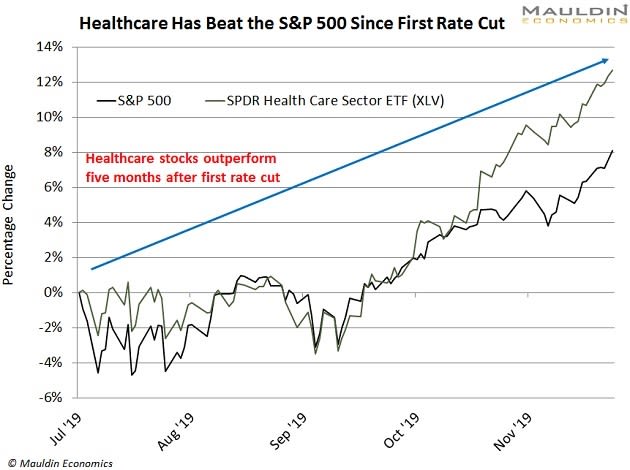
Lower rates prop up healthcare stocks in particular. According to Barclays, they outperform the S&P 500 by an average of 7% in the nine months after an initial interest rate cut, like the one we saw in July.

That was almost five months ago. And the SPDR Health Care Sector ETF (XLV[ARCA] – $101.86 0.20 (0.20%)   )] has climbed 9% since. That’s nearly double the S&P 500’s 5.4% return, as the next chart shows.

Click to enlarge

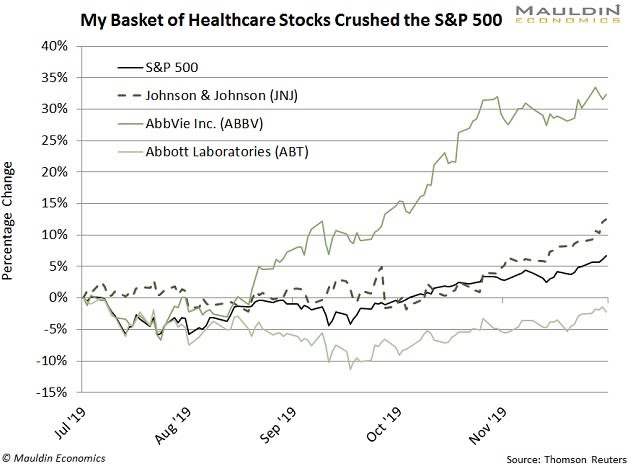
I’ve covered three ways to play this trend back in JulyJohnson & Johnson [ (JNJ[NYE] – $145.87 0.57 (0.39%)    Trade )], AbbVie Inc. [ (ABBV[NYE] – $88.54 0.02 (0.02%)    Trade )], and Abbott Laboratories [ (ABT[NYE] – $86.86 0.06 (0.07%)    Trade )]. Since then, these stocks have climbed an average of 10.1%:

Click to enlarge

That’s more than double the S&P 500’s return over the same period.

Impressive. But remember, if the pattern holds, we’re only halfway through this trend.

The Longview—We’re Getting Old

There are lots of reasons to like healthcare stocks.

To start, America is graying. The share of Americans age 65 and up will jump from 15% in 2018, and up to 21% by 2030.

This has straightforward implications: as people get older, they need more medical care. And it’s one of the last things people skimp on.

In fact, US healthcare spending will grow 5.5% annually through 2027, according to the Centers for Medicare and Medicaid Services (CMS).

Click to enlarge

Consistent spending means healthcare companies earn stable profits, pretty much no matter what.

This makes healthcare stocks ideal for income investors like us.

My New Top Healthcare Picks

Long-term increases in healthcare spending will push healthcare stock prices higher. Add in the short-term interest rate tailwind I mentioned earlier, and you’ve got good reason to hold healthcare stocks today.

The world’s largest medical device company, Medtronic plc (MDT[NYE] – $113.45 0.52 (0.46%)    Trade )], is at the top of my list. The company makes pacemakers, insulin pumps, and surgical tools.

The aging US population will keep these products in high demand for decades. This makes Medtronic’s stock and its 2.0% dividend yield very reliable.

Next on my list is global drug company GlaxoSmithKline PLC (GSK[NYE] – $46.99 0.09 (0.19%)    Trade )].

GlaxoSmithKline makes a variety of well-known medications, from the nasal spray Flonase, to the antidepressant Wellbutrin, to the antacid Zantac.

The company also holds key patents for highly profitable respiratory and antiviral therapies. This gives it very stable sales and profits.

Best of all, GlaxoSmithKline pays a reliable 4.2% dividend yield. That’s over twice the dividend yield on the S&P 500.

Finally, we have Merck & Co. Inc. (MRK[NYE] – $90.95 0.08 (0.09%)    Trade )], another major global drug company. Merck makes a broad range of products, from HIV therapies to insomnia medications and fertility drugs.

It’s also a leading maker of cancer treatments. We all know many cancers get more common with age. So the graying US population will keep Merck’s cancer therapies in high demand.

The company also pays a safe 2.7% dividend yield, which is great for income investors.

Again, I expect this bull market to keep chugging along into 2020. There’s plenty of upside left.

But you still want to control risk by holding safe and reliable dividend-paying stocks. Medtronic, GlaxoSmithKline and Merck fit the bill.

Uber and Postmates Sue To Challenge California’s New Labor Law

uber labor laws

Uber and Postmates Sue To Challenge California’s New Labor Law

SACRAMENTO, Calif. (AP) — Ride-share company Uber and on-demand meal delivery service Postmates sued Monday to block a broad new California law aimed at giving wage and benefit protections to people who work as independent contractors.

The lawsuit filed in U.S. court in Los Angeles argues that the law set to take effect Wednesday violates federal and state constitutional guarantees of equal protection and due process.

Uber Labor Lawsuit

Uber said it will try to link the lawsuit to another legal challenge filed in mid-December by associations representing freelance writers and photographers.

The California Trucking Association filed the first challenge to the law in November on behalf of independent truckers.

The law creates the nation’s strictest test by which workers must be considered employees and it could set a precedent for other states.

The latest challenge includes two independent workers who wrote about their concerns with the new law.

“This has thrown my life and the lives of more than a hundred thousand drivers into uncertainty,” ride-share driver Lydia Olson’s wrote in a Facebook post cited by Uber.

Postmates On-Demand Work Blessing

Postmates driver Miguel Perez called on-demand work “a blessing” in a letter distributed by Uber. He said he used to drive a truck for 14 hours at a time, often overnight.

“Sometimes, when I was behind the wheel, with an endless shift stretching out ahead of me like the open road, I daydreamed about a different kind of job — a job where I could choose when, where and how much I worked and still make enough money to feed my family,” he wrote.

The lawsuit contends that the law exempts some industries but includes ride-share and delivery companies without a rational basis for distinguishing between them. It alleges that the law also infringes on workers’ rights to choose how they make a living and could void their existing contracts.

Democratic Assemblywoman Lorena Gonzalez of San Diego countered that she wrote the law to extend employee rights to more than a million California workers who lack benefits, including a minimum wage, mileage reimbursements, paid sick leave, medical coverage and disability pay for on-the-job injuries.

She noted that Uber had previously sought an exemption when lawmakers were crafting the law, then said it would defend its existing labor model from legal challenges. It joined Lyft and DoorDash in a vow to each spend $30 million to overturn the law at the ballot box in 2020 if they don’t win concessions from lawmakers next year.

“The one clear thing we know about Uber is they will do anything to try to exempt themselves from state regulations that make us all safer and their driver employees self-sufficient,” Gonzalez said in a statement. “In the meantime, Uber chief executives will continue to become billionaires while too many of their drivers are forced to sleep in their cars.”

The new law was a response to a legal ruling last year by the California Supreme Court regarding workers at the delivery company Dynamex.

Google is helping fake CBD review sites rank higher.

Google Fake review sites

Google is helping fake CBD review sites rank higher.

The next time you search reviews for products online including CBD, Google may be giving you fake results.

Search Engine Optimization

SEO or Search Engine Optimization is a constantly evolving and volatile field. Google the largest search engine in the world has had its problems in recent years. In 2016 the search engine delisted Pay Day Loan companies listings.

Now it seems fake review sites are ranking high in the search engine. The problem is that these sites are giving great reviews to certain products and false negative reviews to the competition. This practice is rewarding scammers and content affiliate farms by ranking them based on keywords and content rather than actual products.

Ranking on the first page of Google organically is a way to increase a companies credibility, drive traffic, and sales. What happens when the websites details are hidden and fake review sites are listing higher than legitimate sites.

Google do not let anyone know the algorithm they use to list sites. There is a billion dollar business in just getting ranked in Google. SEO and SEM experts have online discussion about how to rank and what criteria Google is looking for.

In the online marketing world there is always Blackhat techniques, these are techniques used that are not industry defined and considered a bad practice. Think of all the spam emails you get and the robocalls as black hat. Whitehat is using best practices as a way to market products and services that stays clear of any unscrupulous activity.

Google is rewarding bad practices.

By allowing fake review sites to rank higher, especially in the CBD world, Google has let their guard down and let scammers raise for keywords and look legitimate.

If you are looking at review sites on Google or Youtube, please remember that the majority of these sites are affiliate sites, that is, they get a percentage of the profits of you click and buy on one of their links. There is nothing wrong with Affiliate sites, they are important and help build brands and businesses while helping people earn money.

How can legit companies compete when Google rewards bad actors

There have been many references to the issues with Google and its ranking system for review sites mentions of SEO journal and Webmaster forums going back to 2013. Indeed Amazon has had fake reviews on its site by sellers switching great reviewed cheap products for more expensive alternatives. A case where a company selling Apple watch chargers with 200 5 star reviews was flagged when it was found that the reviews were for another finger toy they had listed and swapped out.

CBD Review sites getting dirty how to trust Google

One of the most destructive patterns that will arise though Google not addressing this massive issue is many CBD products will receive bad reviews and negative feedback or just loose sales based on content farms. Will Google address the issue in time or shall it reward bad behavior and help to rank fake review sites over legitimate CBD sites and products.

Report fake review sites to Google

Reporting suspect reviews to Google Small Business support should be your next port of call if your initial flagging did not work. The response you get from flagging a review shouldn’t take more than a week. If, after this time, the review is still there, it’s time to contact Google My Business. You can do this by following these steps.

  1. Log into your Google My Business page here: https://www.google.com/business/
  2. Navigate to the Reviews section
  3. Click the home menu, and then select Support
  4. You can then select a preferred method of contact, either Phone or Email
  5. You will be asked to fill in a few pieces of information. Attach a screenshot example of the suspect review and offer any further information you feel may be helpful.
  6. Submit your complaint. You should hear back within 2 working days.

SPAC deals now are rehabbed and swapped for failed IPOs

Virgin Galactic space company SPAC

SPAC deals now are rehabbed and swapped for failed IPOs

Move over, IPOs, SPACs are becoming more popular.

Special-purpose acquisition companies, once a last resort for owners looking to exit an investment, have become a popular choice for private companies spooked by the swings in the regular IPO market. The volume of SPAC deals hit an all-time high in 2019.

Instead of a regular initial public offering that would raise funds through a share sale, a small but growing number of IPO candidates are choosing to sell themselves to SPACs instead.

Draftkings SPAC deal

DraftKings Inc. is the latest example. The sportsbook operator agreed to sell to Diamond Eagle Acquisition Corp., along with gaming technology firm SBTech, in $3.3-billion deal on Monday. By merging with a SPAC, DraftKings still goes public, but it’s through a reverse merger, or a so-called backdoor listing.

SPAC DraftkingsHaving well-known backers such as blue-chip private equity firms and former public company CEOs involved also has rehabbed the image of SPACs, or blank-check companies that raise money for acquisitions.

It didn’t hurt that billionaire Richard Branson did a SPAC deal too. Still, Branson’s space company, Virgin Galactic Holdings Inc., which went public after merging with a Silicon Valley-based SPAC, is trading lower than where its shares debuted in October.

One of the largest companies to do a SPAC deal after exploring an IPO is Blackstone-owned Vivint. Blackstone had explored an IPO or sale of the technology company and ended up merging it with a SPAC raised by SoftBank’s Fortress Investment Group, in a deal valued at $5.6 billion including debt.

Merging with a SPAC can save a listing candidate months or even a year compared with a regular IPO, said Ryan Maierson, partner at law firm Latham & Watkins.

Uber IPO failed to hit targets

The lackluster showings of ride-hailing companies Uber Technologies Inc. and Lyft Inc. that hurt the IPO market in 2019 have played a big role in the resurrection of SPACs.

IPO is not the only option

“We have a downdraft in IPO activity recently, and SPACs that are looking for a target would be a good fit for companies looking to go public that aren’t finding investors in the IPO market,” Maierson said.

Blank-check companies were created in the 1980s and were associated with fraudulent activity and penny stocks, which gave them a bad reputation. They now have stricter rules.

SPAC is an increasing popular alternative to IPO

SPACs have raised $13.5 billion in the U.S. this year so far, the most on record and surpassing 2007’s $11.7-billion total, according to data compiled by Bloomberg. These firms announced $24.6 billion of acquisitions this year, another record.

Goksu Yolac, JP Morgan’s head of SPACs, estimates there is nearly $19 billion of capital raised via SPACs “that is waiting to be deployed via M&A.”

Private equity firms also like buying companies through SPACs to pay down the target’s debt quicker, said Thomas H. Lee Partners co-President Scott Sperling. The firm bought a healthcare technology company called Universal Hospital Services Inc. in January and renamed it Agiliti.

“It makes for a less risky transaction by de-levering with the SPAC capital,” Sperling said.

The average size of a SPAC raised this year is more than $230 million, compared with about $180 million in 2016, the data showed.

To be sure, SPAC listings come with risks. Target companies often give up more control and economics when they sell to a SPAC, which has its own operating team in place. They’re also subject to a vote by the SPAC shareholders. Sometimes this can lead to deals being scrapped before they can close.

The parent company of CEC Entertainment Inc., which runs Chuck E. Cheese and Peter Piper Pizza, canceled a $1.4-billion merger with a Lion Capital-backed SPAC in July, three months after it was announced.

SPACs continue to attract high-profile dealmakers

Still, SPACs continue to attract high-profile dealmakers. Michael Klein, a veteran banker who founded boutique investment bank M. Klein and Co., raised $690 million via Churchill Capital Corp II, the biggest deal of its type this year. Churchill has held talks to buy Spanish-language broadcaster Univision Communications, people familiar with the matter have said.

Big names such as TPG Capital, Apollo Global Management and the investment bank Centerview all have SPACs now.

“You have very high-profile SPAC issuers in the current times versus pre-crisis when it was lesser known sponsors for the most part,” said Paul Abrahimzadeh, co-head of equity capital markets for North America at Citigroup Inc, the fourth-largest SPAC arranger this year. “They’ve become more mainstream.”